

Advanced Research Journal of Computer Science
ISSN Print: N/A
ISSN Online: 3134-884X
About: The Advanced Research Journal of Computer Science (ARJCS) is a peer-reviewed, open-access journal dedicated to publishing high-quality research and review articles in the field of computer science. ARJCS serves as a global platform for researchers, academicians, and industry professionals to share innovative ideas, cutting-edge developments, and practical applications in computing and information technology.
Publisher Responsibility
Lumina Quest Publishing is responsible for providing the journal with the necessary publishing infrastructure, editorial support, production services, digital preservation, and dissemination of published content. The publisher supports transparent and ethical publishing practices and ensures that the journal’s publishing operations are conducted in accordance with applicable scholarly publishing standards.
The publisher is also responsible for maintaining the journal’s website, publication systems, archiving arrangements, and administrative support while respecting the independence of editorial decision-making.
Editorial Responsibility
The Editor-in-Chief and Editorial Board are responsible for maintaining the academic and scientific quality of the journal. The editorial team oversees the evaluation of submitted manuscripts, selection and coordination of peer reviewers, editorial assessment and decisions, and adherence to the journal’s scope and ethical standards.
Editorial decisions are made independently on the basis of academic quality, originality, methodological soundness, relevance, and ethical compliance, without inappropriate influence from the publisher, authors, reviewers, or commercial interests.
Editorial Independence
The editorial team maintains editorial independence in all decisions concerning manuscript evaluation, peer review, acceptance, revision, and rejection. The publisher does not interfere with the academic judgment of editors or reviewers.
Advanced Research Journal of Computer Science | Year 2024 | Volume 1 | Issue 2 | Pages 8-13
A Centralized Multi-Vendor E-Commerce Stand for Well-organized Online Market Management
Muhammad Bilal 1* , Waqas Ali2 and Muhammad Awais31,2,3Department of Computer Science, Government College University Faisalabad, Pakistan
View PDF Download XML Download DOI XML DOI: 10.66590/arjcs2024010203
Abstract
We need a centralized platform where multiple venders are connected with customers in a single marketplace, this change is compulsory due to rapid growth in E-commerce. In this research paper a platform of multi-vender e-commerce introduce where multiple venders connect to customer this platform enables vender to register themself, mange different products, create stores and process order etc. This platform provides many facilities to customers like browsing required products, applying filtering, online payment, order tracking and secure payment options etc. The proposed system was design using user centered and receptive method through which user can access through multiple devices. For sere side design Hypertext Preprocessor (PHP) used, for dynamic client-side java script and AJAX used for interaction and for data management structural query language server was used. For third party incorporation and payment purpose different e-commerce APIs were used. For data protection and secure payments uses tokenization, authentication, security testing methos and SSL/TLS encoding. The proposed system interface includes login page, registration page, Home page, Vendor store, product detail, checkout and card pages. In this system vendors are connected with customers and the proposed system easily extended with artificial intelligence, modified recommendations and innovative analytics.
INTRODUCTION
The more use of smart phones, digital purchasing and internet usage has totally changed the shopping practices and traditional business. Centralized markets of e-commerce permit the various vendors to sell their products by a single platform, so, customer could get the access of wide range of products without taking the long visit of multiple websites. Present models of market like Alibaba, eBay and Amazon are demonstrating the real value of main platforms, which are used to provide the vendors the wide market access and greater variety of products. This document identifies online operations, wider access, competitive prices and convenience as a great motivation in order to develop such systems [1].
This proposed system is addressing the basic needs of both customers and vendors. So, vendors could create profile, register, upload products, stores, monitor business related activities, processing order and managing stock and prices. Customer could browse different products, using filters and categories, comparing different products, adding items to shopping cart and purchasing different products through a checking process. This platform incorporated support feature, order tracking, ratings and customer reviews in order to enhance transparency and trust [2].
Vendor management has become a very important part of the system. Past research shown in the document has emphasized onboarding of streamline vendors and dedicated dashboard for performance management, sales and products. Competitive pricing, customer services and products quality are mentioned as very important factors for vendor’s success. User experience and interface are also very important for e-commerce platform. Reviews, navigation, filtering, research, ratings and mobile responsiveness can impact the customer confidence and product discovery. This proposing platform follow a responsive and user centered designed approach. The main purpose of this work is to make a centralized market that can provide an integrating environment for customers and vendors while supports future scalability, secure payments, order processing, inventory control and product management.
MATERIALS AND METHODS
This system is designed by using the user-friendly design principles. This documentation proposed customer requirements and understanding of vendors by user journeys, personas, usability testing and user research. A responsive layout, which is based on fluid grids is considered in order to ensure compatibility with the smartphones, tablets and desktops. Consistent interface components, breadcrumbs, filters, categories, search functionality, simple navigation system and very clear architecture of information were incorporated into the various designing approaches.
This platform is containing three main perspectives of users: administrators, vendors and customers. Customer usually interact with the marketplace in order to purchase and search the products and vendors managed stores, while administration monitors the disputes, platform activities, transaction and vendors.
Technologies
The implementation used PHP for authentication and server-based processing, jQuery/JavaScript for interaction with clients, SQL server for storing order, product, vendor and user information and AJAX for the data(asynchronous) exchange. PHP is supporting data base CRUD operation, vendor management and authentication. AJAX and JavaScript also allow the other data and product information to be loading dynamically without the requirement of pages refreshers. This database structure also supports different entities like product, user and information. The information of product includes vendor association, stock level, price, description and name of the product. Other record is containing creation, status, quantity, customer, vendor and product information. Vendor tools like promotion management, pricing management, products listening management, order management and inventory management [3].
Payment and Security
Security wise safe payment process is considered as an important tool of the system. Payment gateway integration could be performed with the help of APIs like JazzCash, Easypaisa and Stripe. This security wise proposed approach includes TLS/HTTPS/SSL encryption, regularly security audits, DSS PCI compliance and tokenization. Process of payment should be tested by using test environment of successful transactions.
This method also considers accessibility and performance. Other resources, scripts and images should be optimized in order to lessen the loading time with mobile interfaces supporting the appropriate touch interaction. Accessibility considerations including keyboard navigation, adequate colors contrasts and alternative texts.
RESULTS AND DISCUSSIONS
This developed system is providing the main components requiring for centralized vendor marketplace. The implemented documentation is presenting separate interface for checkout, cart management, products details, products browsing, vendors store creations and user authentication. These interfaces are supporting the basic leading stages of online shopping.
Figure 1 show the login and signup pages detail where authorized user registers themselves and then login the website. Login page contains user name and password fields if user enter correct data, then user login the website easily.
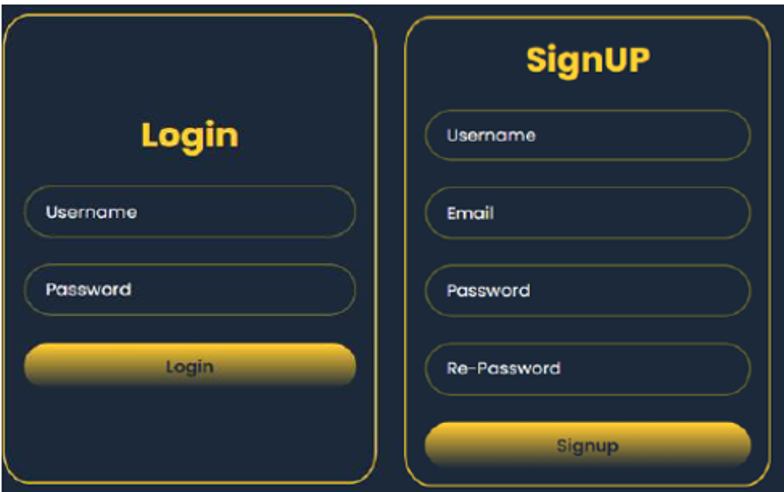
Figure 1: Login and Sign-Up Page
Figure 2 contains information about navigation header, vender page creation and footer where we easily move from one window to the next.

Figure 2: Header Menu, Vendor Store and Footer
Figure 3 contain home page where all information about products is available. This page provide access to customer at marketplace.

Figure 3: Home Page
In multi shop page customer explore the required product. Where different vendors products are available (Figure 4).

Figure 4: Multi Shop Page
As multi-vendor shop shows the different products of different venders (means different vendor combine at one place) but vender shop page shows the individual vender products list (Figure 5).

Figure 5: Individual Vendor’s Store Page
Figure 6 and 7 shows the information about vendor form and contact us page. Further Product related information, add to cart and finally checkout the website is available.
The system participates frontend collaboration, backend processing PHP, database operations are managed by SQL Server, operator communication and dynamic content enable with JavaScript/jQuery and AJAX.
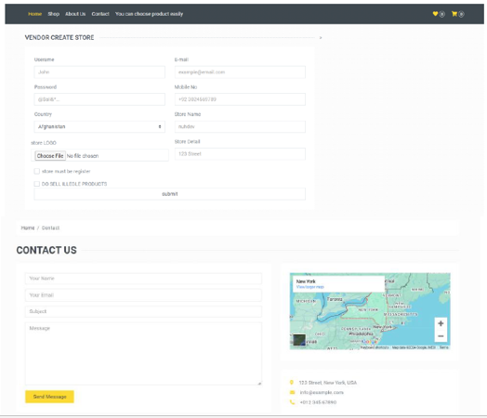
Figure 6: Vendor Create store and Contact us Page
The platform integrates vendor product, greatest, demand, pricing, and elevation organization while allowing customers to search, acquisitions, and track crops professionally [4].
The outcomes bring into line with the works by combination vendor administration, product controller, customer-friendly, hunt and cleaning, and safe expense features in one market scheme.
The podium addresses key safety risks through encoding, tokenization, PCI obedience, and consistent security calculations, while the stated results mainly imitate functional application slightly than statistically authorized presentation or serviceability results.

Figure 7: Product Page, Add cart and Checkout Page
CONCLUSIONS
The research is presenting a centralized e commerce platform, which is designed to connect the customers and vendors with the help of a unified digital marketing. This system is integrating the payment services, checkout, shopping cart functionality, customer browsing, promotions and pricing, order processing, inventory management, product management, store creations and vendors registration.
The implementation process uses e commerce APIs, SQL server, AJAX, Query/JavaScript and PHP in order to support the technical requirements. This platform is also incorporating different security concepts like security testing, tokenization, PCI compliance and TLS/SSL encryption. All those features also providing a strong foundation for a user friendly and scalable environment.
This proposed system is used to support the medium sized and small businesses by allowing the different vendors for operation via a sharing marketplace infrastructure. In future, this system can be advanced through different scalability mechanisms, automated customer support, advancement in analytics, artificial intelligence, personalized products recommendations and machine learning technology. The original documentation identifies machine learning and AI as a potential direction in order to improve the capabilities in future marketplace.
REFERENCES
- Crawford, S. "How the apple iCloud works." HowStuffWorks, August 2011, http://computer.howstuffworks.com/cloud.
- Chow, R. et al. "Controlling data in the cloud: Outsourcing computation without outsourcing control." Proceedings of the ACM Cloud Computing Security Workshop (CCSW '09), November 2009, Chicago, Illinois, USA.
- Dahbur, K. et al. "A survey of risks, threats and vulnerabilities in cloud computing." Proceedings of the 2011 International Conference on Intelligent Semantic Web-Services and Applications, ACM, 2011.
- Jaatun, M, et al. "Special issue on security in cloud computing." Journal of Cloud Computing, vol. 1, no. 1, 2012, pp. 1–2.