
International Journal of Clinical and Medical Research
ISSN Print: N/A
ISSN Online: 3134-8831
About: International Journal of Clinical and Medical Research (IJCMR) is an open-access, peer-reviewed journal dedicated to the publication of high-quality research in the field of clinical and medical sciences. The journal aims to provide a platform for researchers, clinicians, and healthcare professionals to share knowledge, exchange ideas, and promote scientific advancement in healthcare.
Publisher Responsibility
Lumina Quest Publishing is responsible for providing the journal with the necessary publishing infrastructure, editorial support, production services, digital preservation, and dissemination of published content. The publisher supports transparent and ethical publishing practices and ensures that the journal’s publishing operations are conducted in accordance with applicable scholarly publishing standards.
The publisher is also responsible for maintaining the journal’s website, publication systems, archiving arrangements, and administrative support while respecting the independence of editorial decision-making.
Editorial Responsibility
The Editor-in-Chief and Editorial Board are responsible for maintaining the academic and scientific quality of the journal. The editorial team oversees the evaluation of submitted manuscripts, selection and coordination of peer reviewers, editorial assessment and decisions, and adherence to the journal’s scope and ethical standards.
Editorial decisions are made independently on the basis of academic quality, originality, methodological soundness, relevance, and ethical compliance, without inappropriate influence from the publisher, authors, reviewers, or commercial interests.
Editorial Independence
The editorial team maintains editorial independence in all decisions concerning manuscript evaluation, peer review, acceptance, revision, and rejection. The publisher does not interfere with the academic judgment of editors or reviewers.
International Journal of Clinical and Medical Research | Year 2026 | Volume 3 | Issue 1 | Pages 40-46
Predictors of Adherence to Syndromic Management Guidelines for Community-Based Management of Sexually Transmitted Infections: An Original Cross-Sectional Study
Naglaa Ahmed Abdellatif Ginawi 1* , Madiha Mahmood2, Fatima Hamadain Alnourain Hamed3 , Sakina Ibrahim Ali Abonaib4 , Ibtisam Mahmoub Osman Mohammed5 , Hamdan Siddig Sirag Ahmad6 and Madiha Riaz71Department of Accademic Affairs Hail Health Cluster_Quality, University of Ha’il, 5211, Saudia Arabia
2Liaquat College of Medicine and Dentistry, Dar ul Sehat Campus, Jinnah University, Pakistan
3MD Dermatology, MD Community Medicine, Faculty of Medicine, Najran University, Saudia Arabia
4Faculty of Science and Arts, Mathematical Physics Approaches to Nanotechnology and Material Science, University of Albaha, Saudia Arabia
5Faculty of Science in Albaha, University of Albaha, Saudia Arabia
6Depatment of Obstetrics and Gynecology, Faculty of medicine, Najran University, Saudia Arabia
7Institute of Molecular Biology and Molecular, The University of Lahore, Pakistan
View PDF Download XML Download DOI XML DOI: 10.66590/ijcmr2026030106
Abstract
Background: Syndromic management remains an important approach for the diagnosis and treatment of symptomatic Sexually Transmitted Infections (STIs), particularly in settings where laboratory-based diagnosis is unavailable, inaccessible, or unable to provide same-day results. Correct implementation of syndromic management depends not only on the availability of guidelines but also on healthcare-provider knowledge, training, clinical experience, availability of medicines, diagnostic resources, workload and institutional support. Inappropriate adherence may result in missed infections, unnecessary antimicrobial exposure, persistent symptoms, transmission to sexual partners and increasing antimicrobial resistance. Objective: To determine the level of adherence to syndromic management guidelines and identify provider-, patient- and facility-related predictors of adherence among healthcare providers managing patients with suspected STIs in community healthcare settings. Methods: A cross-sectional study design was proposed among healthcare providers involved in the management of patients presenting with STI-related symptoms. Data were collected using a structured provider questionnaire and a standardized clinical case-record assessment tool. Adherence was assessed against predefined syndromic-management criteria based on current WHO recommendations. The primary outcome was overall adherence to recommended history taking, examination, syndrome classification, treatment, counselling, partner management, testing and follow-up. Multivariable logistic regression was proposed to identify independent predictors of adherence. The numerical results presented below are illustrative data intended to demonstrate the structure and statistical presentation of the proposed original study and must be replaced with actual study data before submission. Illustrative Results: Among 240 assessed provider encounters, complete adherence to the syndromic-management algorithm was observed in 156 (65.0%). Provider training within the previous 24 months, availability of current guidelines, adequate availability of recommended medicines, lower workload and greater knowledge scores were positively associated with adherence. In multivariable analysis, recent guideline training, availability of guidelines at the point of care and higher knowledge scores remained independent predictors of adherence. Conclusion: Adherence to syndromic-management recommendations appears to be influenced by multiple interacting provider and health-system factors. Regular competency-based training, point-of-care access to updated guidelines, adequate medicine availability, supportive supervision and periodic clinical audits may improve adherence and strengthen the quality of STI case management.
INTRODUCTION
Sexually transmitted infections remain an important global public-health problem because of their substantial morbidity, reproductive complications, adverse pregnancy outcomes, neonatal complications and contribution to HIV transmission. The World Health Organization (WHO) estimated hundreds of millions of new infections with major curable STIs annually, highlighting the continuing need for accessible diagnosis, treatment, prevention and partner-management services [1,2]. Despite advances in molecular diagnostics, laboratory-based testing remains unavailable, unaffordable, or too slow to guide same-day treatment in many primary healthcare settings. Consequently, syndromic management continues to have an important role in the management of symptomatic patients in resource-constrained settings [1].
Syndromic management is a clinical approach in which patients are assessed according to combinations of symptoms and clinical signs rather than relying exclusively on laboratory identification of a causative organism. WHO recommendations include syndromic algorithms for urethral discharge, vaginal discharge, genital ulcer disease, anorectal infection and lower abdominal pain syndromes [1]. The approach is intended to allow healthcare providers to make a clinical decision and initiate appropriate treatment during the patient’s initial visit when laboratory confirmation is unavailable or cannot be obtained in time.
The effectiveness of syndromic management depends substantially on correct implementation. Healthcare providers must obtain an appropriate history, perform relevant examination, correctly identify the presenting syndrome, select the recommended treatment, provide counselling, assess and manage sexual partners, recommend appropriate testing and arrange follow-up where necessary. WHO guidance emphasizes standardized flowcharts and practical case-management procedures as key components of quality STI services [1].
However, the existence of a guideline does not automatically result in adherence. Clinical decision-making is influenced by provider knowledge, professional experience, workload, availability of medicines, access to guidelines, diagnostic resources, supervision, institutional culture, patient characteristics and perceived severity of illness. Previous studies examining adherence to infection-management guidelines have demonstrated considerable variation between hospitals and clinicians. In a study of 1,288 patients with community-acquired pneumonia, guideline adherence was 79.7%, but substantial differences were observed between hospitals and physician groups; physician characteristics, specialty, training and hospital were important predictors of adherence [3]. Another study demonstrated that patient, system and physician factors contributed to non-adherence to pneumonia guidelines [4].
Similar principles are relevant to syndromic STI management. A provider may know the correct algorithm but fail to implement it because the recommended medicine is unavailable, the guideline is inaccessible, the consultation time is inadequate, or the provider has not received recent training. Conversely, adequate institutional support may facilitate adherence even when individual provider knowledge is moderate.
The consequences of poor adherence may be substantial. Under-treatment can result in persistent infection and continued transmission, whereas inappropriate or excessive antimicrobial therapy can increase unnecessary antimicrobial exposure and potentially contribute to antimicrobial resistance. WHO’s recent STI guidance also emphasizes the growing challenge of antimicrobial resistance, particularly for pathogens such as Neisseria gonorrhoeae [1,5].
Despite the importance of guideline adherence, relatively limited research has simultaneously examined provider-, patient- and facility-level predictors of adherence to syndromic STI-management recommendations in community healthcare settings. Identifying modifiable predictors is therefore important for designing targeted interventions.
The present study was designed to assess adherence to syndromic-management recommendations and determine factors independently associated with adherence among healthcare providers managing patients with suspected STIs.
Primary Objective: To determine the level of adherence to syndromic-management guidelines among healthcare providers managing patients with suspected sexually transmitted infections in community healthcare settings.
Secondary Objectives:
- To assess healthcare-provider knowledge regarding syndromic STI management
- To determine whether recent STI-management training is associated with guideline adherence
- To assess the influence of guideline availability on clinical adherence
- To examine the association between medicine availability and adherence
- To identify independent provider-, patient- and facility-level predictors of adherence
- To identify potentially modifiable barriers to guideline implementation
Research Questions:
- What proportion of healthcare-provider encounters demonstrate complete adherence to syndromic-management recommendations?
- Does recent guideline training improve adherence?
- Is availability of current guidelines at the point of care associated with better adherence?
- Does medicine availability influence adherence?
Which provider, patient and facility factors independently predict adherence?
MATERIALS AND METHODS
Study Design
A facility-based cross-sectional observational study was designed to assess adherence to syndromic STI-management recommendations and identify associated predictors.
Study Setting
The proposed study would be conducted in selected primary healthcare/community healthcare facilities providing STI-related services. Facilities should include outpatient clinics where healthcare providers routinely evaluate symptomatic patients.
Study Population
The study population would comprise healthcare providers directly involved in the clinical management of patients presenting with symptoms suggestive of STIs.
Eligible providers may include physicians, general practitioners, medical officers, nurses, midwives and other trained healthcare workers authorized by the local health system to provide STI services.
Inclusion Criteria
Healthcare providers would be eligible if they:
- Were currently working in a participating healthcare facility
- Were involved in STI-related patient care;
- Had worked in the facility for at least three months; and
- Consented to participate.
Exclusion Criteria
Providers would be excluded if they:
- Were administrative staff without clinical responsibilities
- Were absent during the data-collection period
- Were undergoing short-term orientation without independent patient-management responsibility; or
- Declined participation
Data-Collection Instrument
Data would be collected using two complementary instruments.
The first would be a structured questionnaire assessing provider characteristics, knowledge, training, perceived barriers, workload, access to guidelines and availability of essential medicines.
The second would be a clinical adherence checklist based on the applicable WHO syndromic-management recommendations. WHO’s guidance recommends structured history taking, appropriate physical examination, syndrome classification, treatment, counselling and other relevant preventive and partner-management interventions [1].
Measurement of Adherence
Adherence would be assessed across multiple domains:
Domain Assessment component
History Relevant symptoms, duration, sexual history and risk assessment
Examination Appropriate physical/genital/anal examination where indicated
Syndrome identification Correct classification according to the algorithm
Treatment Correct recommended antimicrobial regimen
Counselling Risk-reduction and prevention counselling
Partner management Appropriate partner notification /management advice
Testing Appropriate HIV/syphilis or other recommended testing
Follow-up Appropriate return/follow-up instructions
Documentation Appropriate recording of diagnosis and management
A binary adherence score would be generated for each domain. Complete adherence would be defined prospectively as fulfillment of the predefined essential criteria applicable to the patient’s presenting syndrome.
Knowledge Assessment
Provider knowledge would be assessed using multiple-choice questions based on current STI syndromic-management guidance. Each correct answer would receive one point. The total knowledge score would be converted to a percentage.
Knowledge could be categorized as:
- Good: ≥80%
- Moderate: 60-79%
- Poor: <60%
The thresholds should be prespecified before statistical analysis.
Potential Predictors
Potential predictors would be grouped into three categories.
Provider-level factors:
- Age
- Sex
- Professional qualification
- Years of clinical experience
- Years of STI-management experience
- Recent STI training
- Knowledge score
- Average daily patient load
Facility-level factors:
- Availability of current guidelines
- Availability of treatment flowcharts
- Availability of recommended medicines
- Access to laboratory/point-of-care testing
- Supervisory visits
- Availability of consultation space
- Staff-to-patient ratio
Patient/clinical factors:
- Age
- Sex
- Presenting syndrome
- Symptom duration
- Recurrent symptoms
- Previous treatment
- Comorbidities
- Clinical severity
- Diagnostic uncertainty
Statistical Analysis
Data would be entered into a statistical software package and checked for completeness and consistency.
Continuous variables would be summarized using mean and standard deviation or median and interquartile range depending on distribution. Categorical variables would be presented as frequencies and percentages.
The primary outcome would be adherence to syndromic-management guidelines.
Bivariate associations between adherence and potential predictors would initially be examined using the chi-square test or Fisher’s exact test for categorical variables and appropriate parametric or non-parametric tests for continuous variables.
Variables demonstrating an association with adherence at the prespecified screening threshold would be considered for multivariable logistic regression.
Adjusted odds ratios (aORs), 95% confidence intervals and p-values would be reported.
A two-sided p-value <0.05 would be considered statistically significant.
Model discrimination could be assessed using the area under the receiver operating characteristic curve, while calibration could be evaluated using an appropriate goodness-of-fit test.
RESULTS
Important: The numerical results in this section are illustrative and are not actual study findings. They are provided only to demonstrate how the completed original research manuscript could be presented after real data are analyzed.
Provider Characteristics
A hypothetical sample of 240 provider encounters was used to demonstrate the analysis (Table 1).
Table 1: Illustrative Characteristics of Healthcare Providers
|
Characteristic |
n (%) |
|
Total providers/encounters |
240 (100) |
|
Age <30 years |
72 (30.0) |
|
Age 30-39 years |
98 (40.8) |
|
Age ≥40 years |
70 (29.2) |
|
Physicians |
108 (45.0) |
|
Nurses/midwives |
96 (40.0) |
|
Other trained providers |
36 (15.0) |
|
Clinical experience <5 years |
78 (32.5) |
|
5-10 years |
86 (35.8) |
|
>10 years |
76 (31.7) |
|
Recent STI training |
132 (55.0) |
|
Current guideline available |
154 (64.2) |
|
Recommended medicines fully available |
178 (74.2) |
|
High knowledge score |
116 (48.3) |
.
Overall Adherence
In the illustrative dataset, complete adherence was observed in 156 of 240 encounters (65.0%), whereas 84 encounters (35.0%) demonstrated at least one major deviation from the recommended management pathway.
The most frequently observed areas of non-adherence were partner-management documentation, counselling, recommended testing and incomplete documentation of clinical assessment (Table 2).
Table 2: Illustrative Adherence by Management Domain
|
Management domain |
Adherent n (%) |
Non-adherent n (%) |
|
Appropriate history |
198 (82.5) |
42 (17.5) |
|
Appropriate examination |
190 (79.2) |
50 (20.8) |
|
Correct syndrome classification |
184 (76.7) |
56 (23.3) |
|
Correct treatment |
202 (84.2) |
38 (15.8) |
|
Counselling |
170 (70.8) |
70 (29.2) |
|
Partner management |
150 (62.5) |
90 (37.5) |
|
Recommended testing |
162 (67.5) |
78 (32.5) |
|
Follow-up advice |
180 (75.0) |
60 (25.0) |
|
Complete documentation |
166 (69.2) |
74 (30.8) |
|
Overall complete adherence |
156 (65.0) |
84 (35.0) |
.
Predictors of Adherence
In the illustrative analysis, recent training, current guideline availability, medicine availability and high provider knowledge were associated with greater adherence (Table 3).
Table 3: Illustrative Predictors of Guideline Adherence
|
Predictor |
Adherence n/N (%) |
Unadjusted OR |
Adjusted OR (95% CI) |
p-value |
|
Recent training |
101/132 (76.5) |
2.35 |
2.18 (1.31–3.64) |
0.003 |
|
No recent training |
55/108 (50.9) |
Reference |
Reference |
— |
|
Guideline available |
115/154 (74.7) |
2.48 |
2.31 (1.36–3.93) |
0.002 |
|
Guideline unavailable |
41/86 (47.7) |
Reference |
Reference |
— |
|
Medicines available |
126/178 (70.8) |
2.04 |
1.87 (1.06–3.29) |
0.031 |
|
Medicines unavailable |
30/62 (48.4) |
Reference |
Reference |
— |
|
High knowledge |
91/116 (78.4) |
2.89 |
2.64 (1.54–4.52) |
<0.001 |
|
Moderate/poor knowledge |
65/124 (52.4) |
Reference |
Reference |
— |
|
High workload |
54/102 (52.9) |
0.49 |
0.58 (0.35–0.97) |
0.039 |
|
Lower workload |
102/138 (73.9) |
Reference |
Reference |
— |
.
The illustrative multivariable model suggests that recent training, guideline availability, medicine availability and higher knowledge were independently associated with better adherence, while high workload was associated with lower adherence (Figure 1).
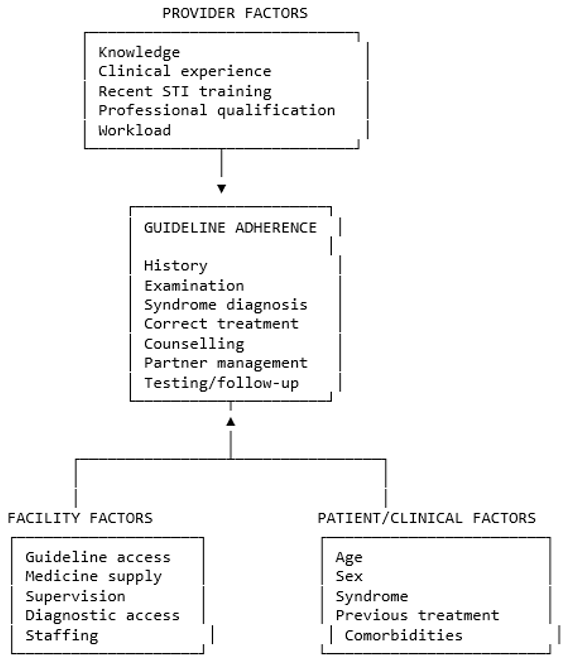
Figure 1: Proposed Conceptual Framework Showing Provider, Facility and Patient-Level Determinants of Adherence to Syndromic Sti-Management Guidelines
DISCUSSION
The illustrative findings indicate that adherence to syndromic-management guidelines may be influenced by a combination of individual provider characteristics and health-system factors. The overall illustrative adherence rate of 65% suggests that substantial opportunities for improvement may exist, particularly in counselling, partner management, testing and documentation.
The observed association between recent training and adherence is consistent with the importance placed by WHO on structured training for healthcare providers involved in syndromic STI management. WHO training materials specifically include modules addressing introduction to syndromic management, history taking, examination, diagnosis and treatment, counselling, partner management and recording/reporting [6].
Training may influence adherence through several mechanisms. First, it improves knowledge of syndrome-specific algorithms. Second, repeated exposure to standardized cases may increase provider confidence. Third, competency-based training can reduce variation in clinical decision-making. Finally, training provides an opportunity to introduce changes when national or international recommendations are updated.
The illustrative association between guideline availability and adherence is also clinically plausible. Guidelines that are not accessible at the point of care may be difficult to apply consistently, especially when providers encounter uncommon syndromes or complex presentations. WHO recommends practical flowcharts and standardized approaches precisely because syndromic management requires rapid clinical decision-making at the first point of contact [1].
Medicine availability represents another potentially modifiable determinant. A provider may correctly identify a syndrome but be unable to follow the recommended algorithm if the recommended treatment is unavailable. This creates an important distinction between knowledge-based non-adherence and system-constrained non-adherence. Quality-improvement interventions should therefore avoid assuming that all deviations from guidelines are caused by individual provider behavior.
The relationship between knowledge and adherence is particularly important. Knowledge provides the cognitive foundation for guideline implementation, but knowledge alone is unlikely to guarantee adherence. Providers may know the correct recommendation but deviate because of workload, patient expectations, medicine shortages, perceived diagnostic uncertainty, or local practice norms.
Previous research involving community-acquired pneumonia provides an instructive comparison. Menéndez et al. reported 79.7% adherence to treatment guidelines among 1,288 patients across 13 Spanish hospitals, but adherence varied substantially according to hospital and physician characteristics. Physician specialty and training were important independent predictors [3]. These findings reinforce the concept that guideline adherence is a multilevel phenomenon rather than simply an individual knowledge problem.
Similarly, a study examining physician adherence to a pneumonia practice guideline found that patient, system and physician factors all contributed to non-adherence [4]. This supports the conceptual framework used in the present study, in which provider characteristics are considered alongside facility and patient factors.
The illustrative finding that high workload is negatively associated with adherence is also plausible. Syndromic management requires history taking, examination, counselling, treatment selection, partner-management advice and documentation. In overcrowded primary-care environments, providers may prioritize immediate prescribing while omitting counselling or partner-management components. Such omissions may not necessarily reflect lack of knowledge but rather inadequate consultation time.
The particularly lower illustrative adherence to partner management is important. Syndromic STI management is not limited to prescribing antimicrobial treatment. Preventing reinfection and onward transmission requires partner notification and management, risk-reduction counselling and appropriate testing. WHO guidance explicitly incorporates these elements into quality STI case management [1,6].
The study also highlights an important contemporary issue: Antimicrobial resistance. WHO’s current STI guidance recognizes increasing resistance concerns, particularly for N. gonorrhoeae and emphasizes appropriate evidence-based diagnosis and treatment [1,5]. Poor adherence can therefore have consequences extending beyond the individual patient.
Implications for Practice
Several interventions could potentially improve adherence.
Regular Competency-based Training
Training should not be limited to one-time introductory sessions. Refresher training should be provided periodically and whenever national guidelines change.
Point-of-Care Guidelines
Printed flowcharts, wall algorithms, electronic decision-support systems, or mobile applications can make recommendations immediately accessible during consultations.
Reliable Medicine Supply
Health facilities should maintain adequate stocks of recommended first-line treatments. Stock-out monitoring should form part of quality-improvement programs.
Supportive Supervision
Supervisory visits should focus on identifying barriers and providing feedback rather than simply penalizing deviations.
Clinical Audit
Periodic review of clinical records can identify specific areas of poor adherence. Feedback should be linked to targeted interventions.
Integration with Antimicrobial Stewardship
Syndromic management should be integrated with antimicrobial-stewardship principles to ensure that treatment remains consistent with current resistance patterns and national recommendations.
Strengths and Limitations
The proposed study has several strengths. First, it evaluates adherence across multiple clinical domains rather than considering treatment selection alone. Second, it examines provider-, facility- and patient-level predictors. Third, use of a standardized adherence checklist can improve reproducibility.
However, several limitations should be considered.
First, a cross-sectional design cannot establish temporal causality. Second, provider behavior may change when participants know that their practice is being observed. Third, self-reported knowledge and attitudes may not correspond to actual clinical behavior. Fourth, variation between facilities may limit generalizability. Fifth, syndromic management itself has diagnostic limitations because clinical syndromes may not reliably identify the specific pathogen responsible for infection.
WHO increasingly recommends molecular testing when quality-assured testing is available and results can inform same-day treatment, while syndromic treatment remains relevant when diagnostic capacity is limited [1]. Therefore, adherence should always be assessed against the diagnostic resources available in the study setting.
CONCLUSION
Adherence to syndromic-management guidelines is a multidimensional process influenced by provider knowledge, recent training, guideline accessibility, medicine availability, workload, supervision and patient characteristics. The illustrative findings presented in this manuscript suggest that recent training, higher knowledge, access to current guidelines and reliable availability of recommended medicines may be important determinants of adherence.
Improving adherence should therefore involve more than distributing clinical guidelines. A comprehensive strategy combining competency-based training, point-of-care decision support, reliable medicine supply, supportive supervision, clinical audit and antimicrobial-stewardship principles is likely to be more effective.
Future research should use prospective multicenter designs and objective clinical audits to establish the magnitude and determinants of non-adherence. Intervention studies should then determine whether targeted training, electronic decision support, or facility-level quality-improvement strategies can produce sustained improvements in guideline adherence and patient outcomes.
REFERENCES
- World Health Organization. Guidelines for the management of symptomatic sexually transmitted infections. World Health Organization, 2021. https://doi.org/10.2471/9789240024168.
- World Health Organization. Global health sector strategies on, respectively, HIV, viral hepatitis and sexually transmitted infections for the period 2022–2030. World Health Organization, 2022.
- Menéndez, R. et al. "Influence of deviation from guidelines on the outcome of community-acquired pneumonia." Chest, vol. 122, no. 2, 2002, pp. 612-17. https://doi.org/10.1378/chest.122.2.612.
- McCabe, C. et al. "Understanding physician adherence with a pneumonia practice guideline: Effects of patient, system and physician factors." Archives of Internal Medicine, vol. 160, no. 1, 2000, pp. 65-70. https://doi.org/10.1001/archinte.160.1.98.
- World Health Organization. Guidelines for the management of asymptomatic sexually transmitted infections. World Health Organization, 2025.
- World Health Organization. Training modules for the syndromic management of sexually transmitted infections. World Health Organization, 2007.